DeepSea
2024
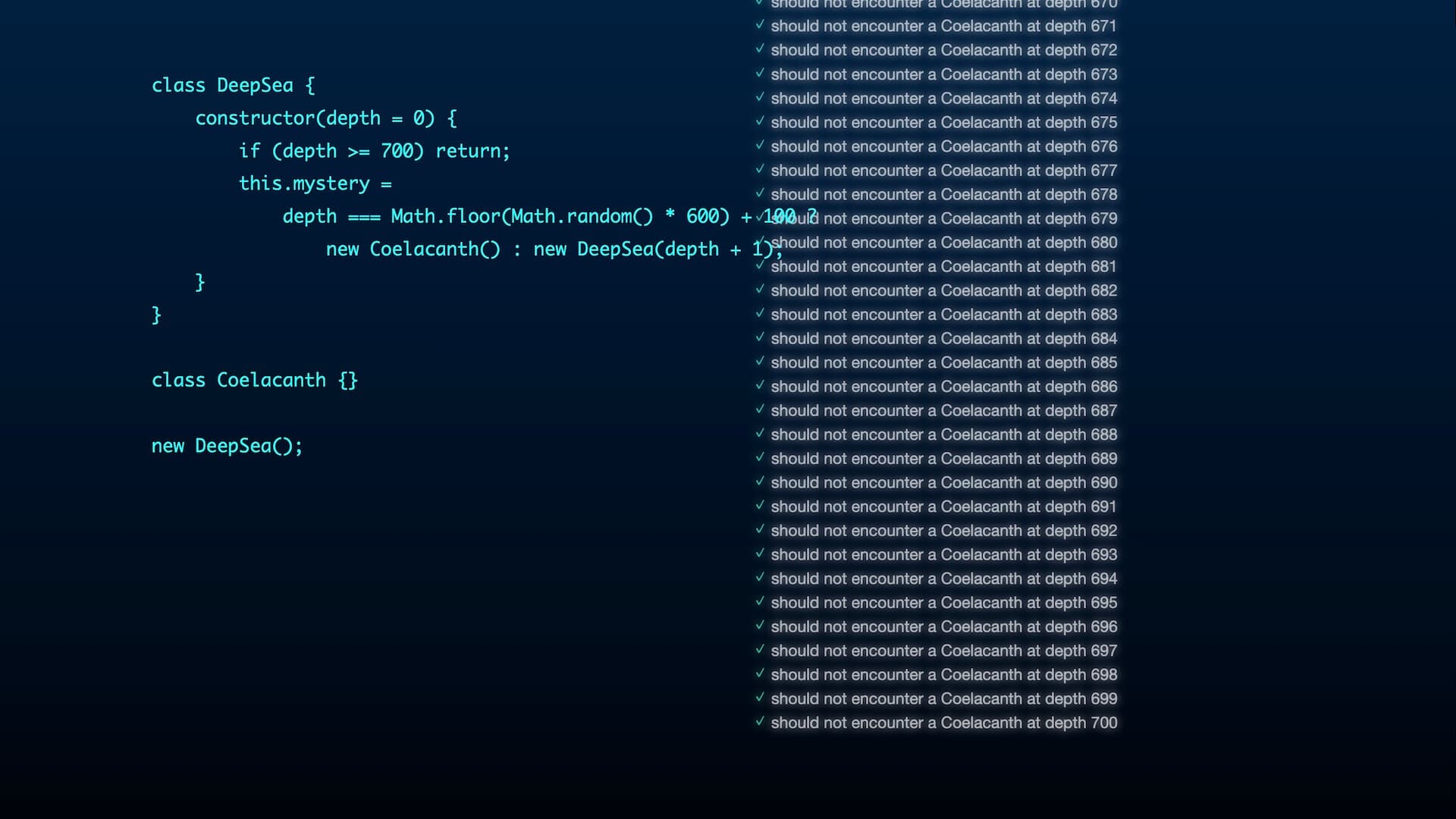
This work is an attempt to explore a short poem written in JavaScript through the act of testing. Testing is an important process in software development, and various tools have been developed to verify the execution results of code. This work incorporates Mocha, a testing framework for JavaScript, and repeatedly tests the code in the browser. At the heart of the work is a class named "DeepSea." This class has a recursive constructor, and when instantiated, it stores another instance in an internal variable called "mystery." In most cases, that instance is another instance of the same "DeepSea" class, but when diving deep enough, there is a small probability that an instance of an ancient fish will be stored instead. I regard this kind of structure as a unique value inherent to programming languages. Even without visualization, I believe this structure itself can be called generative art. The testing framework provides a means to unravel and share its internal state. It reveals the gap between expectation and reality, reminding us of the historical event that ancient fish are still alive. I hope this work will inspire reflection on the relationship between testing and code-based artworks.
この作品は、JavaScriptで書かれた短い詩を、テストという行為を通じて探求する試みである。テストはソフトウェア開発において重要なプロセスであり、コードの実行結果を検証するために様々なツールが開発されている。この作品ではJavaScript用のテストフレームワークMochaを組み込み、ブラウザ上でコードのテストを繰り返し行う。作品の中心には「DeepSea」と名付けたクラスがある。このクラスは再帰的なコンストラクタを持ち、インスタンス化されると内部変数「mystery」に別のインスタンスを格納する。そのインスタンスはほとんどの場合、同じ「DeepSea」クラスのインスタンスであるが、深く深く潜った場合、低い確率で古代魚のインスタンスが格納されることがある。私は、このような構造をプログラミング言語の持つ独自の価値と捉えている。視覚化されていなくとも、この構造そのものがジェネラティブアートと呼べるのではないかと考えている。テストフレームワークは、その内部状態を解き明かし、共有する手段を提供する。これは期待と現実のギャップを明らかにし、古代魚がまだ生きているという歴史的な出来事を思い出させる。この作品が、テストとコード作品の関係について考えるきっかけとなることを願っている。